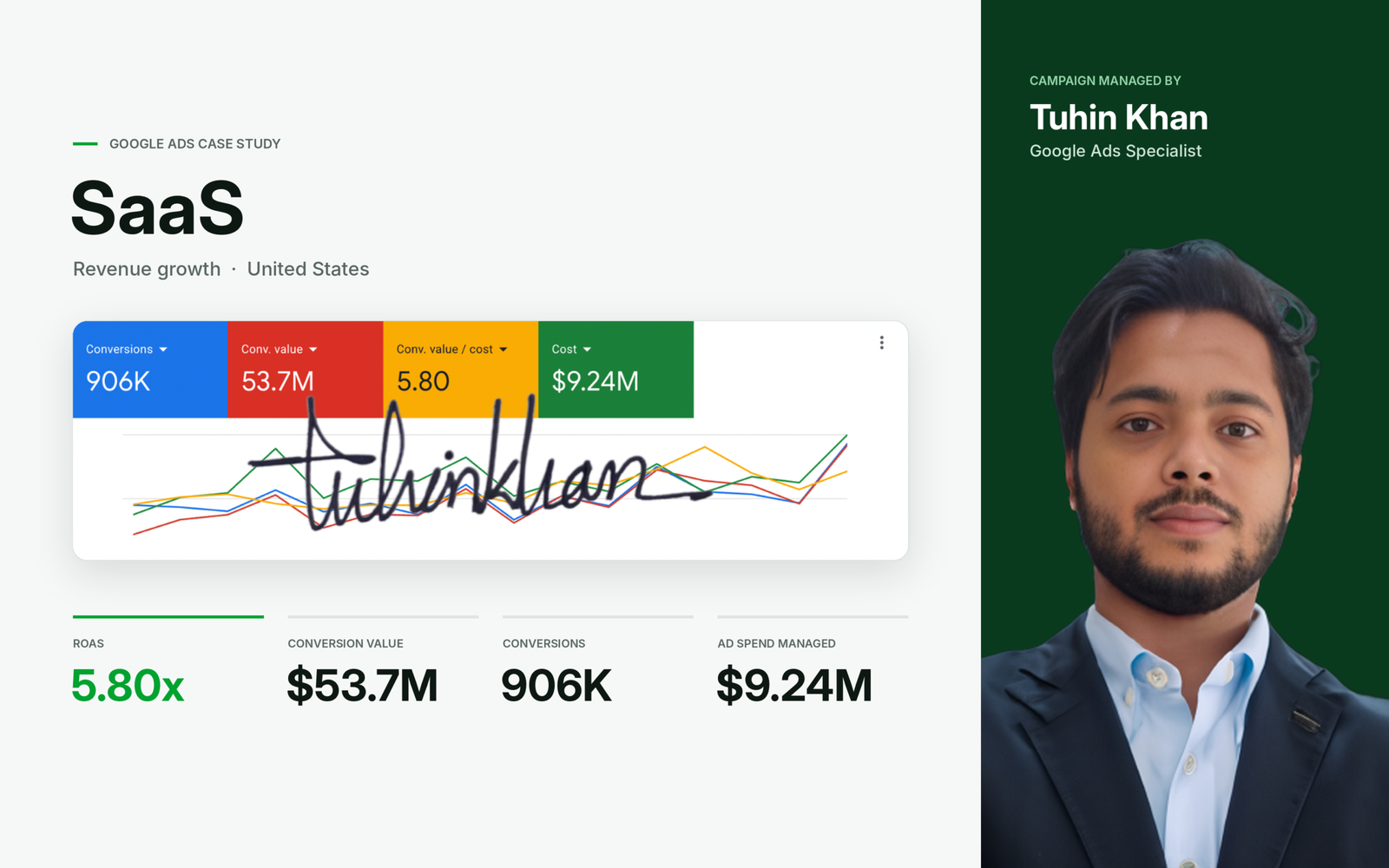


Google Ads for SaaS only works when you optimise for paying customers, not free sign-ups. Here is how a US software company turned $9.24M in ad spend into $53.7M in conversion value.
The Client
A US-Based Software Company Offering System Mechanic with Free Trials and Monthly or Annual Subscription Plans.
The Challenge
- Optimising for the wrong goal: Campaigns were chasing free trials. Lots of people signed up, but many never paid.
- No link between ads and revenue: Payments happened days or weeks later, inside the product, so Google never saw them.
- Expensive competitor keywords: Big category terms were crowded, with high CPCs from well-funded rivals.
- Mixed intent: Searches like “free X tools” and “X login” brought lots of clicks but very few buyers.
What I Did
Connected the CRM to Google Ads. Trial starts, activations and paid upgrades were sent back to Google as offline conversions, each with a real value. Now the algorithm could see which clicks turned into revenue.
Switched to value-based bidding. Once the revenue data was flowing, campaigns moved to target ROAS. Budget shifted toward the keywords and audiences that produced paying customers.
Built campaigns around buying intent. I split the account into high-intent solution searches, “alternative to” and comparison searches, and branded searches, each with its own landing page and target.
Filtered out freebie hunters. Negatives went in for “free”, “crack”, “open source”, “login”, “tutorial” and “jobs”, except where a free plan was the actual offer.
Matched ads to landing pages. Comparison searches went to comparison pages. Feature searches went to feature pages. Each page had one clear call to action.
Google Ads for SaaS: The Results
| Metric | Result |
|---|---|
| Ad spend managed | $9.24M |
| Conversion value | $53.7M |
| Conversions | 906K |
| ROAS | 5.80x |
| Value per conversion | about $59 |
| Cost per conversion | about $10.20 |
Each conversion cost about $10 and brought in about $59 in value. That gap is what let the company keep scaling spend with confidence.
What the Numbers Show
Across 906K conversions, each one cost about $10.20 and brought in about $59 in value. Put another way, the company spent roughly 17 cents on ads for every dollar of conversion value it tracked.
For a subscription business, that ratio matters more than the raw number of sign-ups. A cheap trial that never converts to a paid plan is a cost, not a win. Once the account could see which clicks led to revenue, the cheap but useless traffic stopped getting budget.
The turning point was feeding real revenue data back into Google. With paid upgrades sent back as conversions with values, Target ROAS bidding had something meaningful to optimise towards. That is the difference between Google Ads for SaaS that fills a trial list and Google Ads for SaaS that grows monthly recurring revenue.
The same principle applies to smaller SaaS budgets. Track the event that pays the bills, give it a value, and let bidding learn from it.
Is This Approach Right for Your SaaS?
This works best for SaaS companies with a free trial or freemium plan and a CRM that records when trials become paying customers. If you don’t track paid upgrades yet, that is the first thing to fix, before increasing spend.
The principle behind successful Google Ads for SaaS is the same at any budget: track the conversions that create revenue, give them a value and let bidding learn from them.
What SaaS Teams Can Learn
- Stop bidding on sign-ups alone. Send paid conversions and their value back to Google.
- Comparison and “alternative to” searches are some of the best-converting traffic in SaaS.
- Block freebie and login searches early, or they’ll quietly eat your budget.
Want to Grow Your SaaS with Google Ads?
Book a free Google Ads audit and I’ll show you how to connect your ad spend to real revenue.
Want to see how I work? Read about my Google Ads management services or browse more Google Ads case studies.